

A runner walks into the clinic after taking six weeks completely off.
No trail runs through the Edmonton river valley. No hill repeats. Just walking the dog and resting on the couch.
During those six weeks, their Achilles tendon felt great. No morning stiffness, no persistent throbbing, no sharp pinch. Convinced their body had finally healed, they laced up their shoes on a Saturday morning for an easy two-kilometre jog.
By Sunday morning, the ache was back. Sometimes even sharper than before they took the break.
It is one of the most frustrating, demoralizing experiences an active adult can go through. The immediate thought is almost always:
“Did I break it again? Is my body simply wearing down? Why does resting fix the pain, only for it to return the moment I try to live my life?”
If this scenario sounds familiar—whether with an Achilles tendon, a knee, a shoulder, or tennis elbow—you are not dealing with a failure of your body to heal.
You are dealing with what we call the rest trap.
The Paradox of Pure Rest
Rest is not useless. When a tissue is acutely irritated or overloaded, taking the pressure off for a short window helps settle inflammation, reduce sensitivity, and calm a hyper-reactive nervous system.
That is why taking four weeks off makes you feel better: the day-to-day demand dropped to almost zero.
The problem is that rest is an incomplete intervention. While resting calms down symptoms, it does something else quietly in the background: it lowers your physical capacity.
Muscles, tendons, ligaments, and joints are living, adaptive structures. They maintain their strength, density, and stiffness only when they have a mechanical reason to do so. When you remove that stimulus for weeks at a time, your tissues adapt downward. They become less prepared to handle force.
So what happens when you return to your activity?
- Before your rest, your tissue capacity was, say, a 4 out of 10.
- Your sport or activity demands an 8 out of 10. (Result: Pain and overload.)
- You rested for six weeks. Your symptoms quieted down, but your capacity slipped to a 3 out of 10.
- You return to your sport, which still demands an 8 out of 10.
The demand gap is now wider than it was when you first stopped. As we explored in Tendinopathy Recovery: Why You Must Build Capacity, Not Just Rest, the ache returns not because you failed to rest long enough, but because rest alone does not rebuild capacity.
Demand vs. Capacity: The Real Equation
In modern rehabilitation, we look at persistent pain through a simple relationship:
Demand > Capacity = Symptoms Become More Likely
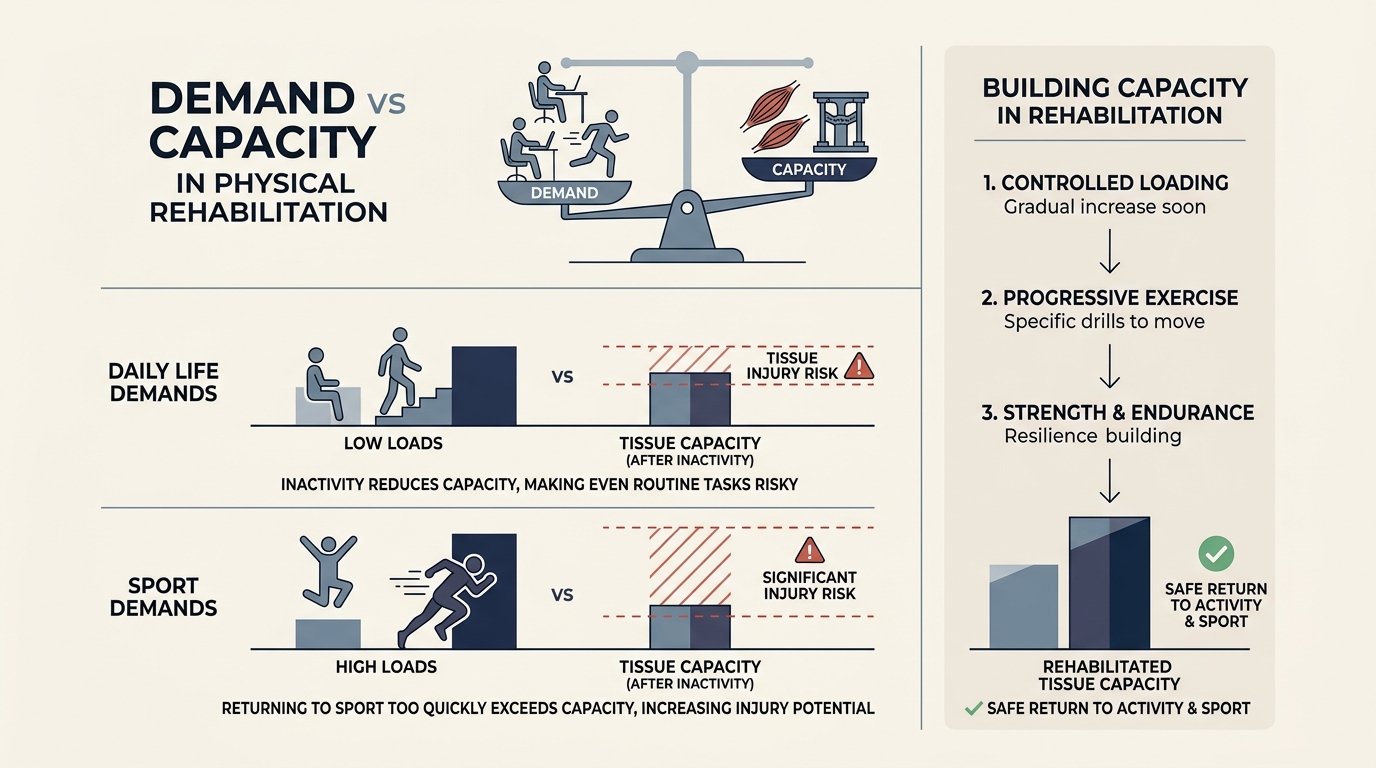
- Demand is everything you ask your body to do: running, hiking downhill, carrying groceries, gardening, working at a desk, lifting weights, or dealing with fatigue and poor sleep.
- Capacity is what your physical system can comfortably tolerate and recover from.
When people get stuck in chronic injury cycles, they usually try to fix the equation by constantly lowering the demand. They stop running. They give up tennis. They avoid stairs. They walk cautiously.
Lowering demand can bring short-term relief, but it shrinks your life. The real objective of sustainable rehabilitation is not to permanently lower the demands of your life. The objective is to systematically build your capacity back up to meet them.
Pain Is Information, Not a Damage Report
When an old ache flares up on your first day back, the instinctive reaction is fear: “I’ve damaged the tissue again.”
In most persistent musculoskeletal conditions—especially tendon pain and tendinopathies—this is rarely true.
Pain is an alarm system, not a damage gauge. After an injury or a period of chronic irritation, your nervous system becomes protective. It lowers its threat threshold. It rings the alarm bells at lower levels of stress—not because tissues are tearing, but because the stress is unfamiliar and exceeds what your system currently feels confident handling.
If you believe that any sensation of pain means damage, you will keep running back to the couch every time your body speaks up. And as discussed in Still Avoiding Things Because They Hurt? Recovery May Need a Different Goal, every time you retreat to complete rest, your capacity drops another notch.
What to Do Instead: Strategic Physical Stress
If pure rest doesn’t rebuild capacity, what does?
The answer lies in a concept called Strategic Physical Stress. Your body adapts when it is exposed to an appropriate physical challenge and given enough time and resources to recover from that challenge.
- Too little stress (prolonged bed rest, complete immobilization) provides no reason for tissues to adapt or get stronger.
- Too much stress (jumping straight back into 18 holes of golf or a 10k run after a month off) overwhelms current capacity and triggers a flare-up.
- Strategic physical stress lives in the sweet spot between the two: enough challenge to stimulate adaptation while remaining well within what your system can recover from.
A great question to ask yourself is:
“What is the most challenging thing I can currently do that settles back to baseline within 24 hours?”
That is your starting line.
- If you can’t run yet, can you do heavy, slow calf raises?
- If you can’t play three sets of tennis, can you do controlled isometric forearm holds?
- If you can’t hike 10 kilometres in the mountains, can you walk 2 kilometres on rolling terrain?
You find where your current threshold is, plant your feet there, and build from that foundation.
The 4 Steps of a Real Recovery Plan
Moving beyond the rest-and-flare cycle requires replacing random tactics with a coherent roadmap:
- Calm Things Down: If your tissue is acutely screaming, temporarily dial back the specific aggravating loads. Note the phrasing: dial back, not shut down entirely. We might swap running for cycling or walking, or use hands-on manual therapy to reduce sensitivity and create a window for comfortable movement.
- Establish Baseline Tolerance: Find what you can do right now with minimal or tolerable discomfort. Tolerable generally means a mild ache (around a 2 to 3 out of 10) that does not worsen overnight and returns to baseline by the next morning.
- Build Strength and Tissue Capacity: Progressively load the tissues. For tendons and muscles, this often involves controlled resistance training, heavy slow resistance, and building strength in the entire movement chain—not just the spot that hurts.
- Bridge to Specific Activity Demands: Before you run, jump, or play, your tissues need to experience higher-rate forces and energy storage. We gradually reintroduce speed, plyometrics, or sport-specific drills in small, controlled doses before returning to full participation.
“What’s the Plan?”
When people visit us at Four Points Health & Wellness in Edmonton, they often arrive with a long list of things they have tried:
- “I iced it.”
- “I got a massage.”
- “I rested for two months.”
- “I tried these three stretches from YouTube.”
None of those is a plan. Those are isolated tactics. (Read more on this distinction in The Power of a Plan: How to Stay Healthy and Navigate Physical Challenges).
What active adults actually need when dealing with persistent pain is clarity:
- Where am I now? (What is my current baseline capacity?)
- Where am I trying to get? (What specific activity or sport do I want to return to?)
- What do I work on next? (What is the immediate next progressive step?)
- How will I know I’m improving? (What functional milestones tell me I’m building capacity?)
When you have a structured roadmap, you stop guessing. You stop dreading setbacks. And you stop letting an injury dictate what you can and cannot enjoy in life.
Ready to Build Your Recovery Plan?
If you have a persistent condition, recurring injury, or uncertainty keeping you from running, hiking, working out, or simply feeling capable in your body, let’s talk.
At Four Points Health & Wellness in Edmonton, we combine hands-on manual therapy, shockwave therapy when appropriate, and clear, active rehabilitation planning.
Book an Assessment with Paul Cramer to find your baseline, build your roadmap, and get back to the activities that matter to you.


